
Have you ever modeled a reading strategy, practiced it with your students, and then handed out an independent activity—only to discover that several students still weren’t sure what to do?
They seemed to understand during the lesson. They answered your questions. Some even explained their thinking beautifully.
But when it was time to work on their own, things didn’t go quite as planned.
Sometimes the problem isn’t the strategy we’re teaching. It’s that students need more support between watching us demonstrate a skill and doing it independently.
That’s where I Do, We Do, You Do comes in.
This instructional approach, often called the gradual release of responsibility, helps us move students from teacher modeling to guided practice and eventually independent application.
It’s familiar to many teachers, but a few small adjustments in how we use each stage can make a real difference.
What Is I Do, We Do, You Do?
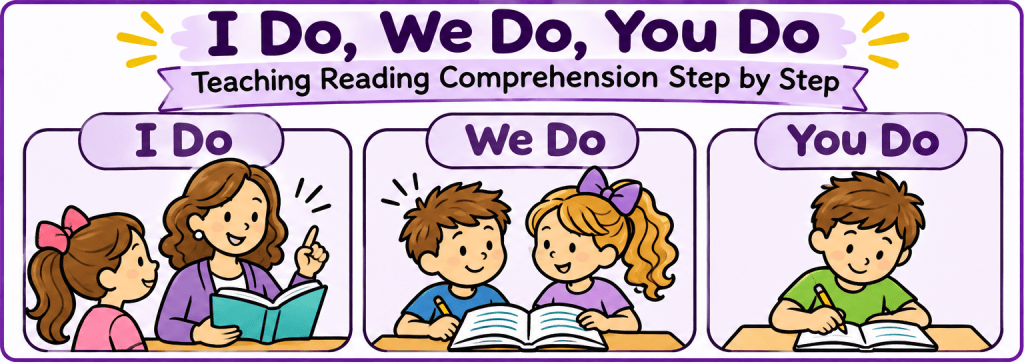
The idea behind gradual release is fairly simple. At the beginning of a lesson, the teacher takes most of the responsibility for demonstrating a new skill. As students gain understanding, that responsibility gradually shifts to them.
The three familiar stages are:
- I Do: The teacher models the skill and explains the thinking behind it.
- We Do: The teacher and students practice the skill together, with guidance and feedback.
- You Do: Students apply the skill with less support, giving the teacher an opportunity to see what they understand.
Think of it as showing students how to do something, helping them practice, and then giving them a chance to try it independently.
But there’s an important part we sometimes overlook.
Students don’t all move toward independence at the same pace.
Some may be ready after one guided example. Others may need more modeling, additional practice, or a chance to work with a partner before trying the strategy alone.
And that’s okay.
Why Does Gradual Release Work for Reading Comprehension?
Reading comprehension involves a lot of thinking that isn’t immediately visible.
When readers make inferences, ask questions, visualize, or monitor their understanding, much of that thinking happens silently.
We can’t expect students to use these strategies independently if we haven’t shown them what the thinking actually looks and sounds like.
That’s why modeling is so important.
The What Works Clearinghouse guide, Improving Reading Comprehension in Kindergarten Through 3rd Grade, recommends explicitly teaching comprehension strategies through modeling, guided practice, and gradual release toward independent application.
Rather than simply telling students to “make an inference,” we demonstrate how readers combine text clues with what they already know.
Then we give students opportunities to practice that thinking with support before asking them to do it on their own.
Let’s look at what this might sound like in a second- or third-grade classroom.
Teaching Inferences with I Do, We Do, You Do
Making inferences is a good example because students often understand the idea of using clues but struggle to explain how those clues support their thinking.
Here’s a short lesson you can use with almost no preparation.
1. I Do: Let Students Hear Your Thinking
Best for: Introducing a strategy and showing students how readers think
Begin with a short passage:
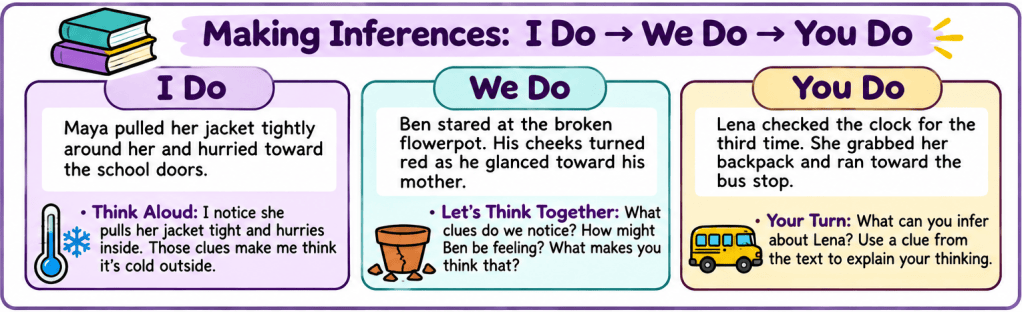
Maya pulled her jacket tightly around her and hurried toward the school doors.
Read it aloud, then model your thinking.
You might say:
“I’m noticing that Maya pulled her jacket tightly around her. She also hurried inside. The author never tells us what the weather is like, but those details make me think it’s cold outside.”
Point out the clues that helped you reach that conclusion.
You can even underline pulled her jacket tightly and hurried toward the school doors so students can see the evidence.
Then explain that you used clues from the text and what you already know about being cold to make an inference.
Teacher Tip: Keep your think-aloud short and focused. You don’t need to explain every thought that crosses your mind. Choose the thinking you want students to learn, demonstrate it clearly, and move on.
2. We Do: Let Students Help with the Thinking
Best for: Practicing the strategy with teacher guidance
Now introduce another short passage:
Ben stared at the broken flowerpot. His cheeks turned red as he glanced toward his mother.
Read the passage together.
Instead of immediately explaining what Ben might be feeling, invite students to contribute.
Ask:
“What do you notice about Ben?”
“What clues might help us figure out how he’s feeling?”
“Why do you think the author mentions his cheeks turning red?”
Students might suggest that Ben is embarrassed, nervous, or worried.
Encourage them to explain their thinking.
If a student says Ben is worried, ask which details support that idea.
You might help the class put its thinking into a sentence:
“Ben might be worried because he looks at the broken flowerpot and then glances toward his mother.”
Notice that you’re still providing support, but students are doing more of the thinking.
Those classroom conversations are an important part of guided comprehension practice. If you’re looking for ways to get students talking more thoughtfully about what they read, I share additional ideas in Engaging Texts and Discussions Boost Reading Skills.
Teacher Tip: Resist the temptation to answer your own questions too quickly. Give students a little time to think, then invite them to explain their ideas. If they struggle, offer a helpful prompt rather than immediately supplying the answer.
3. You Do: Give Students a Chance to Try
Best for: Checking whether students can apply the strategy independently
Once students have practiced with you, give them a new passage:
Lena checked the clock for the third time. She grabbed her backpack and ran toward the bus stop.
Ask students:
“What can you infer about Lena? Use a clue from the text to explain your thinking.”
Students might infer that Lena is running late or worried about missing the bus.
Have them write a short response or explain their thinking orally.
Then look closely at their answers.
Did they make a reasonable inference? Did they identify a clue? Can they explain how the clue supports their thinking?
Those answers help you determine what students need next.
Teacher Tip: Don’t confuse completing the activity with understanding the strategy. A student might give a reasonable answer but still need help explaining the evidence. That’s useful information for your next lesson.
What If Students Aren’t Ready for the You Do?
This is where gradual release becomes especially valuable.
It’s tempting to think that every lesson has to move neatly through all three stages before the reading block ends.
But learning doesn’t always work that way.
If students are still struggling during guided practice, there’s nothing wrong with modeling another example.
If some students are ready to work independently while others need support, you can adjust accordingly.
For example, you might:
- Provide another guided example for a small group.
- Give students an opportunity to discuss their thinking with a partner.
- Offer a sentence stem such as “I think ___ because the text says ___.”
- Use a shorter passage with more obvious clues before moving to a more challenging one.
What matters is that students are gradually taking responsibility for the skill.
And sometimes that takes more than one lesson.
The Difference Between Helping and Doing the Thinking for Students
One of the trickiest parts of gradual release is knowing when to step in.
We’ve all worked with students who look at us after every question, waiting for a hint that will lead them to the answer.
Of course we want to help. But if we’re always supplying the clues, students may not learn to find them independently.
Instead of telling a student what to notice, try asking:
“Where could you look for a clue?”
“What have you already figured out?”
“Which part of the story helped you decide?”
These questions still provide support, but they leave the thinking with the student.
And as students become more confident, you can gradually remove those prompts.
Can You Use This Approach with Other Reading Strategies?
Absolutely!
Once you’re comfortable with gradual release, you can use it to teach a variety of comprehension skills.
| Reading Skill | What You Could Model |
|---|---|
| Making Predictions | Using story clues to predict what might happen next |
| Visualizing | Describing the mental picture created by an author’s words |
| Monitoring Understanding | Recognizing confusion and deciding when to reread |
| Summarizing | Identifying important events and leaving out minor details |
| Analyzing Characters | Using actions and dialogue to infer character traits |
The key is to model the actual thinking involved in the skill, not just demonstrate how to complete a worksheet.
For example, when teaching summarizing, explain how you decide which details are important enough to include.
When teaching monitoring comprehension, show students what you do when a sentence doesn’t make sense.
Monitoring comprehension is another skill that benefits from teacher modeling. Students need to see what we do when reading stops making sense before they’re expected to recognize and fix those problems on their own. I explore this in The Importance of Comprehension Monitoring in Early Reading.
Then let them practice making those decisions with support.
Supporting Multilingual Learners
Gradual release can also provide helpful structure for multilingual learners.
During the I Do, model the strategy using clear language, gestures, and visual clues. Introduce unfamiliar vocabulary that students need in order to understand the passage.
During the We Do, allow students to rehearse their ideas with a partner before sharing with the class.
Sentence stems can also help:
- “I noticed ___ in the story.”
- “I think ___ because ___.”
- “One clue is ___.”
When students begin working independently, they may still benefit from visual supports or opportunities to explain their thinking orally.
Remember that needing language support doesn’t necessarily mean a student doesn’t understand the comprehension strategy.
See I Do, We Do, You Do in Action
Sometimes it helps to actually see a teaching technique in a classroom.
In this Edutopia video, Using I Do, We Do, You Do to Teach Reading With Expression, first-grade teacher Rebecca Piotrowski demonstrates gradual release during oral reading.
Students first listen to a fluent model, then practice reading with the teacher, and finally read with greater independence.
Although the video focuses on reading fluency rather than comprehension, the instructional approach is the same.
It’s a helpful reminder that gradual release isn’t limited to one reading skill or grade level.
Try It Tomorrow!
Choose one comprehension strategy your students are currently learning.
Then plan a short lesson using these three steps.
1. I DO — Model the Thinking
Choose a short passage and think aloud as you demonstrate the strategy.
2. WE DO — Practice Together
Use a second passage. Ask students to identify clues, explain their ideas, and help you apply the strategy.
3. YOU DO — Try Independently
Give students a new passage and listen to or read their responses to see whether they can apply the strategy.
Before moving on, ask yourself:
“Who is ready to work independently, and who still needs a little support?”
That question can help guide what you do next.
You don’t need a complicated lesson plan or a new set of materials. You may already have everything you need in the story you’re reading with your class.
The important part is being intentional about who is doing the thinking at each stage.
And remember, gradual release doesn’t mean we stop helping students. It means we’re helping them become less dependent on us as they learn to use reading strategies for themselves.
That’s what we’re working toward—readers who can think, question, and make meaning from text with growing confidence.
Further Reading
If you’d like to learn more about gradual release and reading instruction, these resources are worth exploring:
- What Works Clearinghouse: Improving Reading Comprehension in Kindergarten Through 3rd Grade — Research-based recommendations for modeling and teaching comprehension strategies.
- Edutopia: Using I Do, We Do, You Do to Teach Reading With Expression — A classroom video demonstrating the gradual release approach.
- Douglas Fisher: Revisiting the Rules of Gradual Release of Responsibility — An explanation of how focused instruction, guided instruction, collaboration, and independent learning can work together.
Thank you for supporting Got to Be LIT, a small teacher-created business dedicated to making literacy instruction meaningful and manageable.
💜FREE Reading Response Toolkit!
Get 6 FREE reading activities for grades 2–3! Strengthen comprehension with versatile graphic organizers, plus receive practical teaching tips and classroom ideas and occasional freebies.


