
Have you ever taught a phonics pattern, practiced it with your students, and then wondered why some of them couldn’t remember it the next day?
They might read a word correctly during the lesson but struggle when they see that same spelling pattern in a different word.
Sometimes students need another way to make the connection between letters and sounds. And sometimes, that means getting out of their seats!
One of my favorite ways to teach phonics is to have students use their whole bodies to represent letters and spelling patterns. The movements are fun, of course, but they also give students a way to see and act out what is happening in a word.
Using movement during phonics instruction gives students another way to connect the letters they see with the sounds they hear. It can be especially helpful when reviewing patterns with students who still need extra support.
And you don’t need an elaborate activity to try it.
Why Use Movement During Phonics Instruction?
Think about how much we’re asking students to remember when they learn a new phonics pattern.
They need to recognize the letters, connect them to the correct sounds, blend those sounds into words, and eventually use that knowledge when reading and spelling.
That’s quite a bit to manage!
One approach researchers have explored is called embodied learning. Simply put, it means using purposeful physical movement to reinforce what students are learning.
In a 2022 study involving 149 children ages 5–6, researchers found that students who learned letter-sound relationships using whole-body movements developed stronger letter-sound knowledge than students who learned without movement. However, the study did not find the same improvement in whole-word reading.
That’s an important distinction.
Movement may help students remember a sound-spelling connection, but they still need plenty of opportunities to use that knowledge when reading and spelling.
And because this particular research involved younger children learning early letter-sound relationships, we shouldn’t assume the same results for every second-grade phonics skill.
Still, the idea of using purposeful movement can be a useful addition to explicit phonics instruction.
Here are a few ways I’ve used movement or would incorporate it into a second-grade classroom.
1. The Silent E Kick!
Best for: Teaching the vowel-consonant-e pattern
One of my favorite ways to teach silent e is to have students become the letters in a word.
I call four students to the front of the classroom and give each one a letter from the word take. Each student had a part to play, but the student representing the final e had a special job.
I tell students that silent e is sneaky. He could creep up on the vowel without making a sound!
When it was time, the student playing e would pretend to give the a a little kick (without actually touching anyone).
The surprised a would shout his name: “Ā!”
And the e? He stayed completely silent.
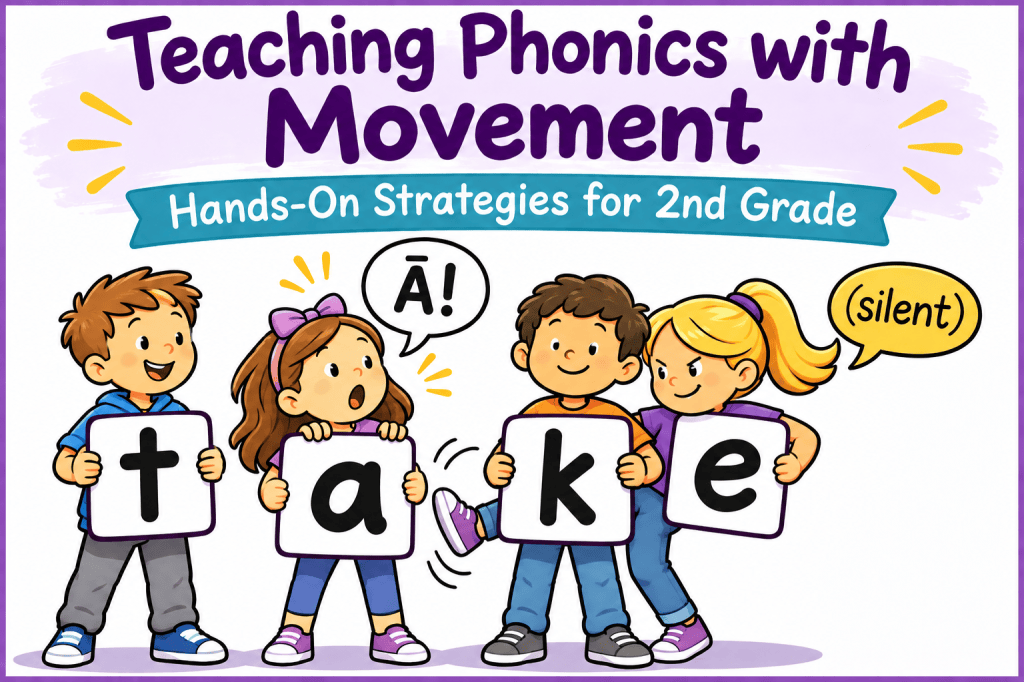
Of course, the students enjoy acting it out. But there is a reason for the movement. I want them to remember that in many vowel-consonant-e words, the final e is silent and the first vowel represents its long sound.
After the demonstration, we practice reading other words that follow the same pattern.
Try starting with word pairs so students can see what changes:
- cap → cape
- tap → tape
- mad → made
- kit → kite
Have students identify what changed, say the new vowel sound, and read the whole word.
Teacher Tip: The Silent E Kick is a memorable way to introduce the pattern, but be sure to follow it with word building, decoding, and spelling practice. Students need to recognize the pattern on the page, not just remember the action.
Also, remind students that this is a common spelling pattern, not a rule that works for every word ending in e.
2. Vowel Teams: Two Letters Working Together
Best for: Teaching vowel teams such as ai and oa
When two vowels work together to represent one sound, why not let two students work together, too?
For example, when teaching ai in rain, invite two students to the front of the classroom. One represents a, and the other represents i.
Challenge them to work together to form a giant capital A using their arms.

As they form the letter, both students say the long-a sound, /ā/, together.
You can do something similar with oa in boat.
This time, have the students work together to create a large O shape while saying /ō/.
Here’s the part I especially like: Let students come up with their own movements!
They don’t need to twist themselves into complicated positions. They can use their arms or think of another simple way to create the letter shape.
Then ask, “Why did you choose that movement?”
The goal is for students to connect the written vowel team with the sound it represents.
After each demonstration, have students identify the vowel team, say the sound, and read a few words containing the pattern.
For ai, try rain, train, and paint.
For oa, use boat, coat, and road.
Teacher Tip: Keep the spelling pattern visible throughout the activity. Students should see ai or oa, say its sound, make the movement, and then practice reading and spelling words containing that vowel team.
Students also need to learn that vowel teams can represent different sounds. These movements are for the specific patterns being taught, not a rule for every two-vowel combination.
3. Digraph Partners: Two Letters, One Sound
Best for: Helping students recognize consonant digraphs
Digraphs are another good opportunity to bring movement into phonics instruction.
Take the sh digraph.
Invite two students to represent s and h. Have them stand apart at first, then move together and join hands.
Explain that these two letters work together to represent one sound: /sh/.
Ask the class to say the sound as the students join together.
Then write several words containing sh:
ship, shop, fish, wish
Have students find the digraph in each word and practice reading the words aloud.
You can repeat the activity with ch and th, making sure students understand that the two letters work together to represent one sound.
Teacher Tip: Remind students that a digraph represents one sound, even though it’s spelled with two letters. When reading ship, for example, students should recognize /sh/ as one sound rather than trying to blend /s/ and /h/ separately.
4. Build and Change Words with Your Body
Best for: Helping students notice how changing letters changes words
This activity works well when students are learning to add, remove, or substitute letters.
Give three students the letters c, a, and p.
Have the class blend the sounds and read cap.
Now invite another student holding e to join the end of the word.
Ask students what changed.
They should notice that the spelling now follows the vowel-consonant-e pattern.
Have the class read cape, explaining how the vowel sound changed.
You can also reverse the process. Remove the final e and ask students to read cap again.
The physical movement allows students to see exactly which letter changed and what happened to the word.
Try other transformations such as hop → hope and pin → pine.
Teacher Tip: Have students write each new word after the demonstration. This helps connect what they’re seeing and hearing with the written spelling pattern.
5. Let Students Create the Movements
Best for: Reviewing familiar phonics patterns
Once students understand the idea of using movement to represent sounds and spellings, let them become the teachers.
Choose a phonics pattern students have already learned, such as ai, oa, sh, or vowel-consonant-e.
Give partners or small groups a few minutes to create a simple movement that represents the pattern.
Then have them demonstrate it for the class.
Ask the other students to identify the pattern, say its sound, and read an example word.
What I like about this variation is that students have to think about the relationship between the letters and sounds before deciding how to represent it.
And sometimes their ideas are more creative than anything we would have planned!
Teacher Tip: Ask students to explain how their movement represents the sound or spelling pattern. That explanation matters more than how clever the movement looks.
Making Movement Work for Every Student
Not every student will be comfortable standing at the front of the classroom or moving into a particular position, and that’s perfectly fine.
Students can use their hands, arms, letter cards, or small movements while seated. Partners can also demonstrate the movements while other students participate by identifying sounds, reading words, or building words with letter tiles.
For multilingual learners, model the pronunciation clearly and provide visual examples of the spelling pattern. Let students rehearse the sounds and movements with a partner before participating in front of the class.
It’s also helpful to introduce unfamiliar word meanings. Students may be able to decode a word correctly without knowing what it means.
And remember, the activity shouldn’t become a guessing game. Teach the sound-spelling relationship explicitly before asking students to demonstrate it.
The movement is there to support the learning, not replace the instruction.
Don’t Forget the Reading and Spelling!
Here’s something worth keeping in mind with movement-based phonics activities.
A student might remember exactly how silent e sneaked up and kicked the vowel but still struggle to read hope or spell made.
That doesn’t mean the activity was wasted. It means we need to take the next step.
After the movement, have students work with the actual words.
Ask them to identify the spelling pattern, say the appropriate sounds, blend the word, and read it. Then dictate a few words so students can practice spelling the same pattern.
The What Works Clearinghouse foundational reading guide recommends explicitly teaching students to decode words, analyze word parts, and write and recognize words.
That’s the connection we want to make.
The movement helps students notice and remember the pattern. Reading and spelling practice help them learn to use it.
As students become more confident, gradually remove the movement and see whether they can recognize the pattern independently.
Try It Tomorrow!
You don’t have to plan an elaborate phonics lesson to give this approach a try.
Start with a pattern your students are currently learning.
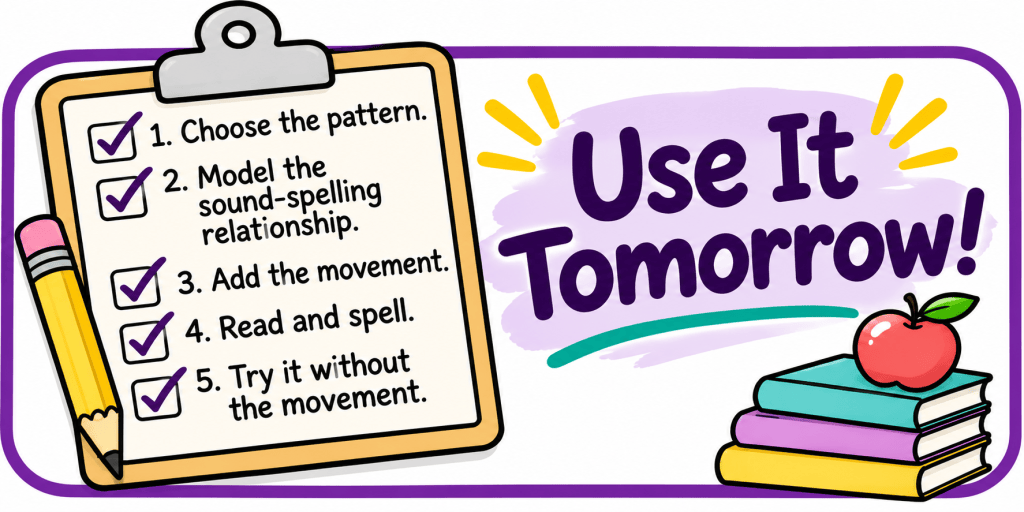
- Choose the pattern. Silent e, ai, or oa would be good starting points.
- Model the sound-spelling relationship. Show students the letters, explain the pattern, and demonstrate the sound.
- Add the movement. Invite students to represent the letters or work together to create a movement that illustrates the sound.
- Read and spell. Give students several words containing the pattern. Have them read the words and write a few from dictation.
- Try it without the movement. See whether students can recognize and use the pattern independently.
That’s it!
You can use this during whole-group phonics instruction, small-group intervention, or a quick review of a previously taught skill.
And don’t worry about making every movement perfect. The important part is helping students connect the letters they see with the sounds they hear and say.
Sometimes having students stand up, work together, and act out a phonics pattern gives them another way to make sense of something that has been difficult to remember.
The fun is a bonus. The real goal is helping students become more confident, independent readers and spellers.
Further Reading
Interested in learning more about phonics instruction and purposeful movement?
- Reading Rockets: Phonics in Practice — Examples of hands-on phonics activities and guidance for gradually removing supports.
- What Works Clearinghouse: Foundational Skills to Support Reading for Understanding in Kindergarten Through 3rd Grade — Evidence-based recommendations for teaching decoding, word analysis, spelling, and connected-text reading.
- Effects of 8 Weeks with Embodied Learning on Children’s Pre-reading Skills — A randomized study examining whole-body and hand movements in early letter-sound instruction.
- A Better Way to Learn Your ABCs – A YouTube video by Edutopia showing that integrating whole-body movements into learning the alphabet improves students’ recollection of letter-sound pairings and hard-to-learn sounds.
Thank you for supporting Got to Be LIT, a small teacher-created business dedicated to making literacy instruction meaningful, engaging, and manageable.
💜FREE Reading Response Toolkit!
Get 6 FREE reading activities for grades 2–3! Strengthen comprehension with versatile graphic organizers, plus receive practical teaching tips and classroom ideas and more freebies directly in your inbox.


