
Have you ever listened to a student read aloud and thought, They know all the words, so why does their reading still sound so choppy?
Sometimes students can recognize the words on the page but haven’t quite figured out how to put them together so their reading sounds natural. They pause in odd places, rush through punctuation, or read everything in the same flat voice.
Telling them to “read with more expression” doesn’t usually help much. They need to hear what fluent reading sounds like.
That’s where echo reading comes in.
It’s a simple strategy that doesn’t require special materials or a complicated lesson. You read a sentence or short passage aloud, and your students repeat it, paying attention to how you grouped the words, where you paused, and how your voice changed.
It’s a small addition to your reading routine that gives students a chance to hear fluent reading and practice it with support.
What Is Echo Reading?
Echo reading is an oral reading technique in which the teacher reads a short section of text aloud, and students repeat it, trying to match the teacher’s phrasing, pace, and expression.
Think of it as an echo. You read first, and your students’ voices follow.
For example:
Teacher: “Stop!” shouted Mia. “That’s my backpack!”
Students: “Stop!” shouted Mia. “That’s my backpack!”
As you read, emphasize Stop! and change your voice to show Mia’s feelings. Then have students repeat the sentence, using similar expression.
You can do this with a whole class, a small group, or an individual student. The key is to keep the sections short enough that students can remember and imitate how the words were read while following along in the text.
Why Does Echo Reading Help?
Reading fluency involves three important skills:
- Accuracy: Reading words correctly
- Automaticity: Recognizing words quickly and effortlessly
- Prosody: Reading with appropriate expression, phrasing, and attention to punctuation
Echo reading is especially helpful for practicing prosody.
We’ve all heard students read a sentence one word at a time, pausing between words even when they know what those words mean. Echo reading gives us a chance to show them how those words fit together.
Research supports providing students with fluent reading models and opportunities for guided oral reading practice. Reading Rockets emphasizes modeling expressive reading and giving students opportunities to practice reading passages aloud.
Echo reading is one simple way to put those recommendations into practice.
It’s worth remembering, though, that students who struggle to read words accurately still need explicit instruction in decoding and word recognition. Echo reading can support their fluency practice, but it isn’t a replacement for those foundational skills.
How to Use Echo Reading in Your Classroom
You don’t need to set aside an entire lesson for echo reading. Start with a short passage and choose one fluency skill to focus on.
Here are five ways to make it work in your second- or third-grade classroom.
1. Start with a Familiar Passage
Best for: Introducing echo reading and building confidence
Choose a short paragraph, poem, or section from a story students already know. Dialogue is especially useful because it gives students a reason to change their voices.
Read one sentence aloud while students follow along. Then have them echo it.
Continue with the next sentence, gradually increasing the length as students become comfortable.
Teacher Tip: A passage from a recent read-aloud can work beautifully. Since students already know what is happening in the story, they can give more attention to how the words sound.
2. Let Punctuation Guide the Reading
Best for: Teaching expression and appropriate pauses
Have you ever heard a student read straight through a question mark as though it were a period?
Rather than reminding students to watch their punctuation marks, let them hear the difference punctuation makes.
Write these sentences where everyone can see them:
You’re coming with us?
You’re coming with us!
Read the first sentence with a questioning voice, then have students echo it.
Next, read the second sentence with excitement and let students repeat it.
Ask, “What changed about the way I read those sentences?”
Students will usually notice that the words stayed the same, but your voice changed.
Teacher Tip: Resist the temptation to correct everything at once. If you’re working on expression, let that be the focus. You can tackle phrasing another day.
3. Practice Reading in Meaningful Phrases
Best for: Students who read word by word
Some students pause after nearly every word, even when they can read those words accurately.
Try writing this sentence on the board:
After the rain stopped, the children hurried outside to play.
First, read it slowly, pausing after individual words. Then read it naturally.
Ask students which version was easier to understand.
Next, show them how the words fit together in phrases:
After the rain stopped, / the children hurried outside / to play.
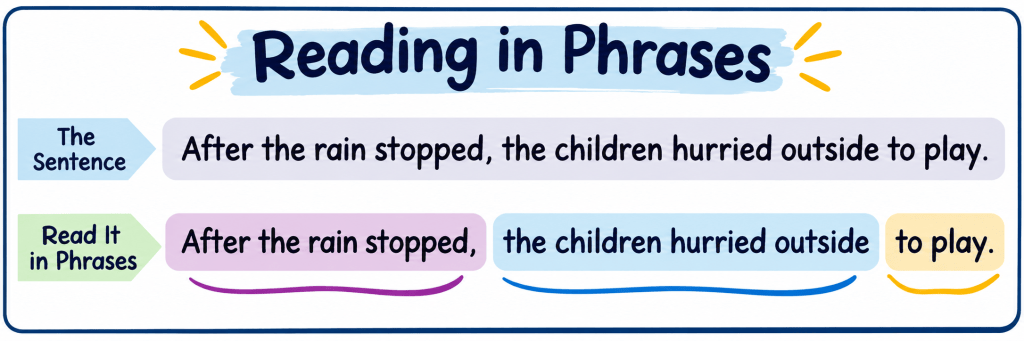
Read each phrase aloud and have students echo it.
Then remove the phrase marks and read the whole sentence together.
Teacher Tip: Phrase marks can be a helpful temporary support, but we don’t want students to depend on them. The goal is for students to recognize natural phrasing as they read.
4. Use Character Dialogue to Practice Expression
Best for: Connecting fluent reading with comprehension
Dialogue is one of my favorite ways to make expression meaningful rather than something students simply imitate.
Consider these sentences:
“I can’t believe we won!” shouted Ben.
“I can’t believe we won,” whispered Ben.
Read each sentence aloud, changing your expression to match the dialogue tag.
Have students echo each one.
Then ask: “Why did we read those sentences differently?”
Students must think about the meaning of the words and the character’s feelings to answer.
That’s an important connection. Fluent reading isn’t about making our voices sound entertaining. It’s about reading in a way that reflects the meaning of the text.
Teacher Tip: Before reading dialogue, ask students how the character might be feeling. Then let them decide how their voices should sound.
5. Gradually Remove the Teacher Support
Best for: Helping students apply fluency skills independently
Echo reading works best when students eventually practice without relying on your voice.
After echoing a short passage, ask students to read it again on their own.
Listen for the skill you’ve been practicing. Are they pausing at punctuation? Are they grouping words naturally? Does their expression match what’s happening in the story?
If a student struggles, model the sentence again and let them try it once more.
You can also have students reread the passage with a partner once they’re comfortable reading the words accurately.
Teacher Tip: Students may sound wonderful when they’re copying your reading, but can they do it without you? That independent rereading helps you see whether they’re beginning to use the skill themselves.
Echo Reading vs. Choral Reading vs. Waterfall Reading
These three techniques give students opportunities to practice oral reading with support, but they aren’t quite the same.
| Technique | How It Works |
|---|---|
| Echo Reading | The teacher reads a short section first, and students repeat it. |
| Choral Reading | The teacher and students read the same text aloud together. |
| Waterfall Reading | Students gradually join an ongoing oral reading until the group is reading together. |
I especially like echo reading when students need help with phrasing or expression. They hear the sentence first, then get to try it while the model is still fresh in their minds.
Choral reading provides ongoing support because students read together. Waterfall reading gradually brings more voices into the reading, which can make oral reading feel less intimidating.
If you enjoy using echo reading, you might also like my article on Waterfall Reading Techniques, another way to make oral reading practice more comfortable for students.
Supporting Multilingual Learners with Echo Reading
Echo reading can be particularly helpful for multilingual learners because they get to hear English pronunciation, phrasing, and intonation before trying it themselves.
A few small adjustments can make the activity more effective.
Introduce unfamiliar vocabulary first. If a passage includes words students may not understand, take a moment to explain them using pictures, gestures, or a quick example.
Keep the sections short. Start with a phrase or single sentence rather than expecting students to repeat an entire paragraph.
Allow partner practice. Some students may feel more comfortable rehearsing with a partner before reading aloud to the group.
Check for understanding. Just because a student can repeat a sentence accurately doesn’t mean the student understands it.
For example, after echoing The frightened rabbit darted beneath the fence, ask students to show or explain what darted means.
The goal is to help students develop fluent reading while continuing to build vocabulary and comprehension.
How Do You Know If Echo Reading Is Working?
You don’t need an elaborate assessment to see whether students are making progress.
Choose a short passage and listen to a student read it before beginning echo reading practice. Pay attention to one or two specific skills.
Maybe the student pauses after nearly every word. Perhaps the reading sounds flat, even when the passage contains excited dialogue.
After several opportunities to practice, listen again.
Are you hearing fewer awkward pauses? Is the student paying more attention to punctuation? Does the reading sound more natural?
And don’t forget to check comprehension. Ask a quick question about what was read.
Remember that sounding fluent on a practiced passage is only a starting point. Continue listening during regular reading activities to see whether students are applying those skills to other texts.
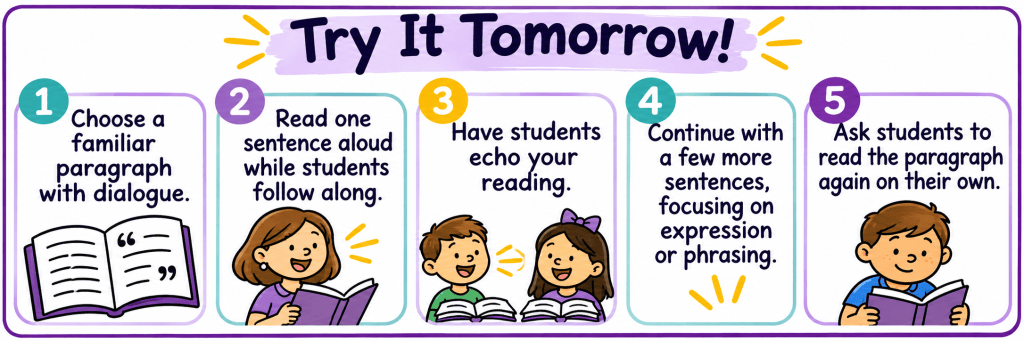
Try It Tomorrow!
Here’s a quick way to introduce echo reading without adding another complicated activity to your literacy block.
- Choose a familiar paragraph with a few lines of dialogue.
- Read one sentence aloud while students follow along.
- Have students echo your reading.
- Continue with a few more sentences, focusing on expression or phrasing.
- Ask students to read the paragraph again without your model.
That’s it!
You can use echo reading during small-group instruction, with a short poem, or while revisiting a favorite passage from a read-aloud.
And remember, you don’t need to practice every aspect of fluency in one sitting. Choose a skill, give students a good model, and let them practice.
Sometimes hearing how a sentence should sound is just what a student needs to begin reading it more naturally.
Further Reading
If you’d like to learn more about research-aligned reading fluency instruction, these resources are worth exploring:
- Reading Rockets: Fluency Instructional Guidelines and Student Activities — Practical guidance for modeling fluent reading and providing meaningful oral reading practice.
- The Reading League: Curriculum Evaluation Guidelines — Research-aligned guidance on reading instruction, including teacher modeling, oral reading practice, accuracy, and prosody.
Thank you for supporting Got to Be LIT, a small teacher-created business dedicated to making literacy instruction meaningful and manageable.
💜FREE Reading Response Toolkit!
Get 6 FREE reading activities for grades 2–3! Strengthen comprehension with versatile graphic organizers, plus receive practical teaching tips and classroom ideas.


