
When my son was learning to read, he became quite good at decoding words. He could work his way across a page and read the words aloud—but he was not always paying attention to what those words meant together. Sometimes he would read a word incorrectly and continue without noticing that the sentence no longer made sense.
I realized that being able to decode the words was only part of the work. He also needed to learn to listen to himself as he read—to notice when something sounded wrong, stop, and figure out what had happened.
You may have seen the same thing with a student. The sentence sounds silly. It does not match the words on the page. It may not make sense at all. Yet the student reaches the period and moves right into the next sentence.
This is a common challenge for beginning readers. Learning to read is not only about saying the words. Students also need to notice when the words they read do not make sense and know what to do next.
That is where comprehension monitoring comes in.
What Is Comprehension Monitoring?
Comprehension monitoring is the habit of thinking about whether reading makes sense. A reader who monitors understanding does not simply move from one word to the next. The reader notices confusion, pauses, and takes action.
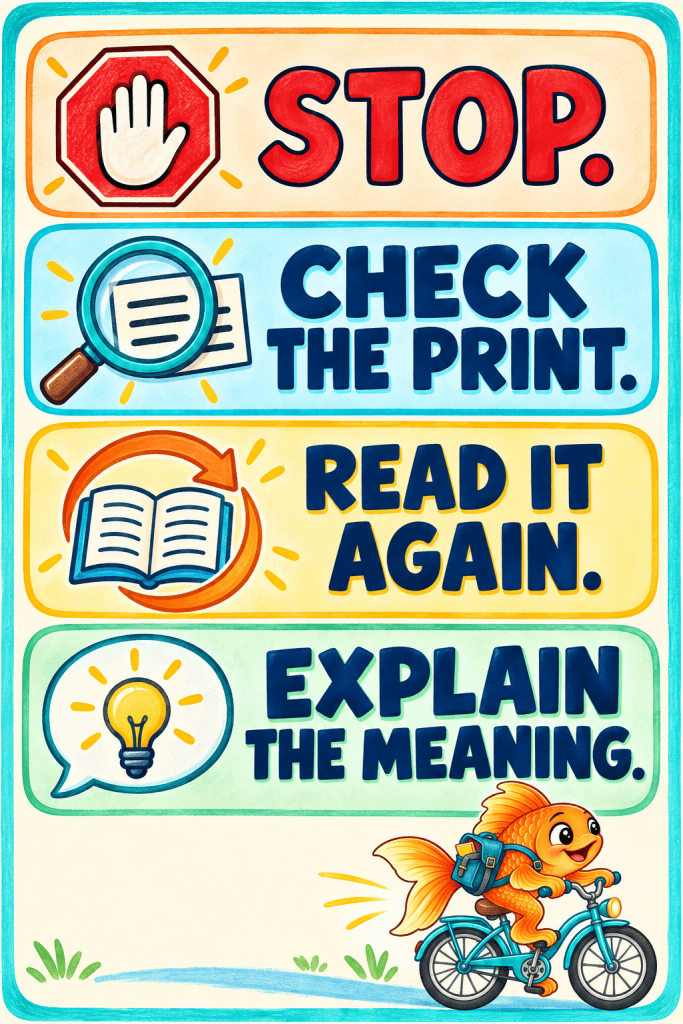
For young readers, that action can be taught through one clear routine:
- Stop. Notice that something does not sound right or make sense.
- Check the print. Look closely at the words and all the letters.
- Read it again. Reread the whole sentence or the part that caused confusion.
- Explain. Tell what the sentence or passage means.
The final step matters. Reading a sentence correctly is important, but correct word reading is not the end goal. We want students to connect accurate reading with understanding.
Why “Read It Again” Is More Than a Reminder
Teachers say “read it again” all the time. However, students may not know what to do differently during that second reading.
Read it again, Johnny.
Effective rereading has a purpose. A student might reread to:
- correct a word that does not match the print;
- make a confusing sentence sound right;
- find an important detail;
- confirm an answer with text evidence; or
- explain the big idea more clearly.
When we name that purpose, rereading becomes a strategy instead of a command. Students begin to understand that good readers are not readers who never make mistakes. Good readers notice when meaning breaks down and know how to repair it.
Begin with Sentences That Make Students Laugh
One easy way to introduce monitoring is with sentences that are obviously sensible or silly.
For example:
We wore our mittens because the snow was cold.
That makes sense.
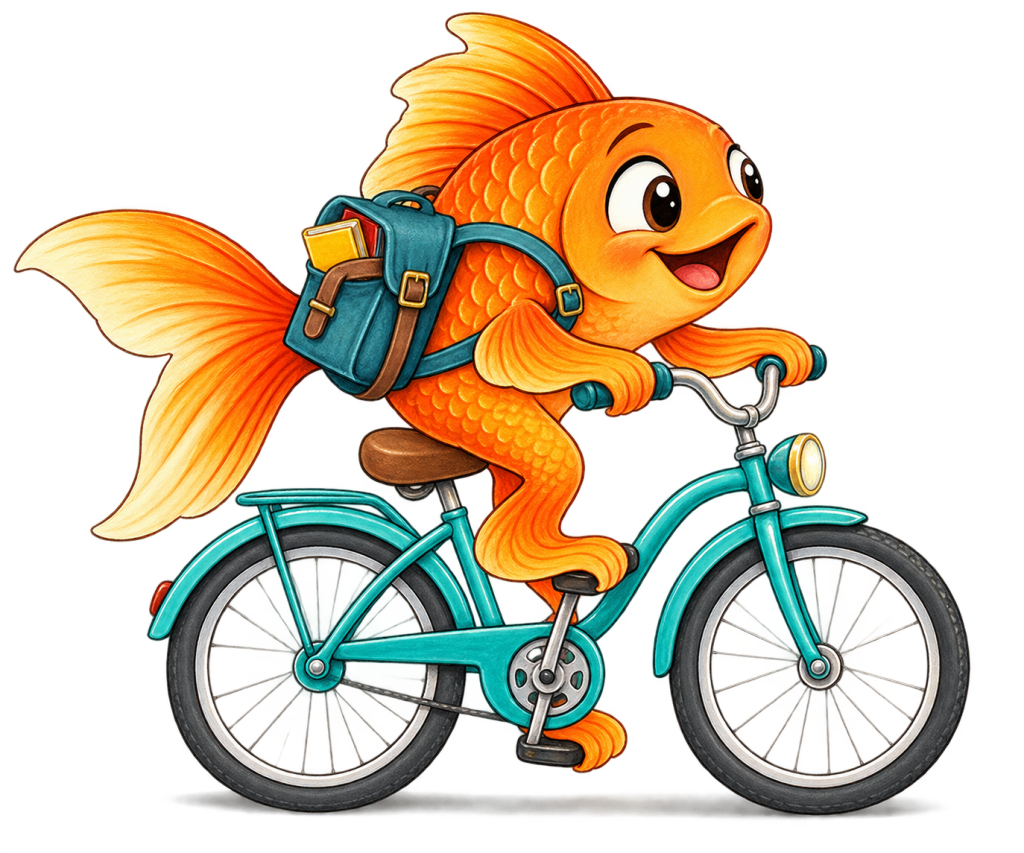
The fish rode a bicycle to the library.
That sounds silly.
Ask students to decide whether each sentence makes sense and explain how they know. If a sentence is silly, invite them to change one part so the new sentence makes sense. Then have them say or read the complete repaired sentence.
This playful practice gives students permission to question what they hear. It also helps them see themselves as active meaning-makers. They are not just receiving words; they are checking those words against what they know.
As students become more confident, move from obviously silly ideas to smaller mistakes that require closer attention.
Teach Students to Check the Print
Meaning is only one part of self-monitoring. Students also need to compare what they said with what is actually printed.
Try displaying a sentence while intentionally reading one word incorrectly. Students listen, follow the print, and signal when they hear a mismatch. Then ask:
- What word did I say?
- What word is printed?
- What did you notice in the letters?
- Can you reread the entire sentence accurately?
- What does the sentence mean?
This routine keeps attention on the text. Students learn to use the letters and their taught decoding skills instead of replacing an unfamiliar printed word with a guess that merely seems to fit the sentence.

After modeling, let partners take turns being the “reading detective.” One student follows the print while the other reads, and then they switch roles. Keep this work supported until students can respond accurately and kindly.
Move from One Sentence to Connected Text
Once students can notice problems in individual sentences, help them apply the same thinking to a short passage.
A simple three-read structure works well:
First read: What is this mostly about?
Students read to form an initial understanding. They can give a brief oral response, point to a picture, or name the topic.
Second read: Which details help you know?
Students return to the passage and locate words or sentences that support their thinking. They might underline, highlight, point, or read the evidence aloud.
Third read: How can you explain it clearly?
Students use the evidence they found to explain the meaning in their own words.
This progression shows students that rereading is not a punishment for getting something wrong. It is a normal way to deepen understanding.
Helpful Prompts for Small-Group Reading
The language we use can make students more independent. Instead of immediately identifying an error or supplying a word, try prompts that return responsibility to the reader:
- Did that make sense?
- Does that match the print?
- Look closely at the whole word. What do you notice?
- Which part should you read again?
- What changed after you reread it?
- Which words helped you understand?
- Tell the idea in your own words.
Choose the prompt that matches the problem. If a student misread a printed word, direct attention to the letters and known sound-spelling patterns. If the words were read accurately but the meaning is unclear, guide the student back to the relevant sentence or detail.
Keep the Routine Visible
Young readers benefit from seeing the same language in different settings. A small poster, bookmark, or desk reminder can make the routine easy to recall:
Stop. Check the print. Read it again. Explain the meaning.
Model it during whole-group instruction. Practice it together in a small group. Then place familiar activities in a literacy center after students know the routine. During independent reading, celebrate when a student stops and rereads without being prompted. That moment of self-correction is evidence that the student is beginning to take charge of understanding.
A Ready-to-Use Way to Practice
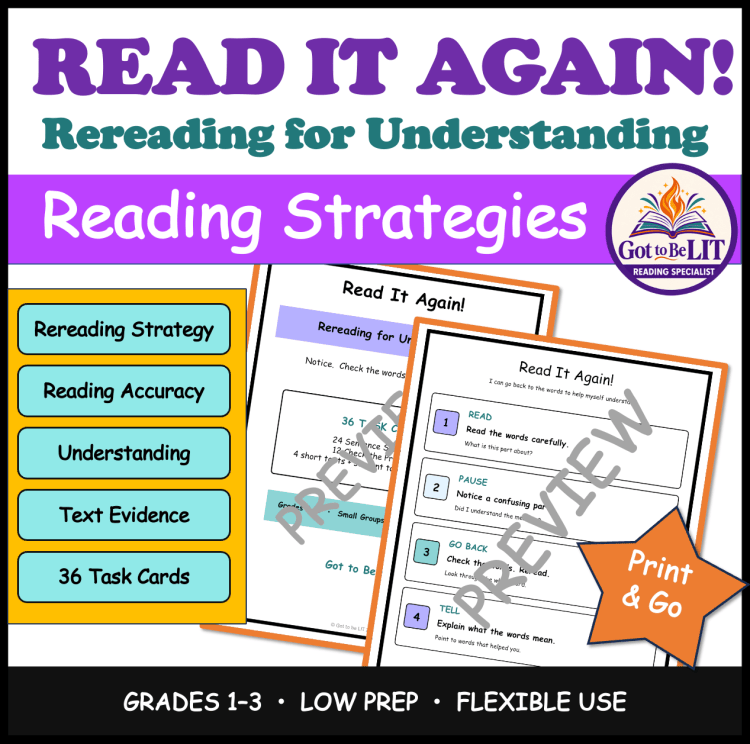
I created Read It Again! to give first- and second-grade students repeated, supported practice with this process. The printable resource moves through three kinds of work:
- Sentence Sense: Students decide whether everyday and silly sentences make sense, explain their thinking, and repair the silly ones.
- Check the Print: Students compare a teacher’s reading with the printed sentence, catch deliberate errors, reread accurately, and explain the message.
- Read for Meaning: Students read short connected texts for the big idea, return to find evidence, and explain their understanding.
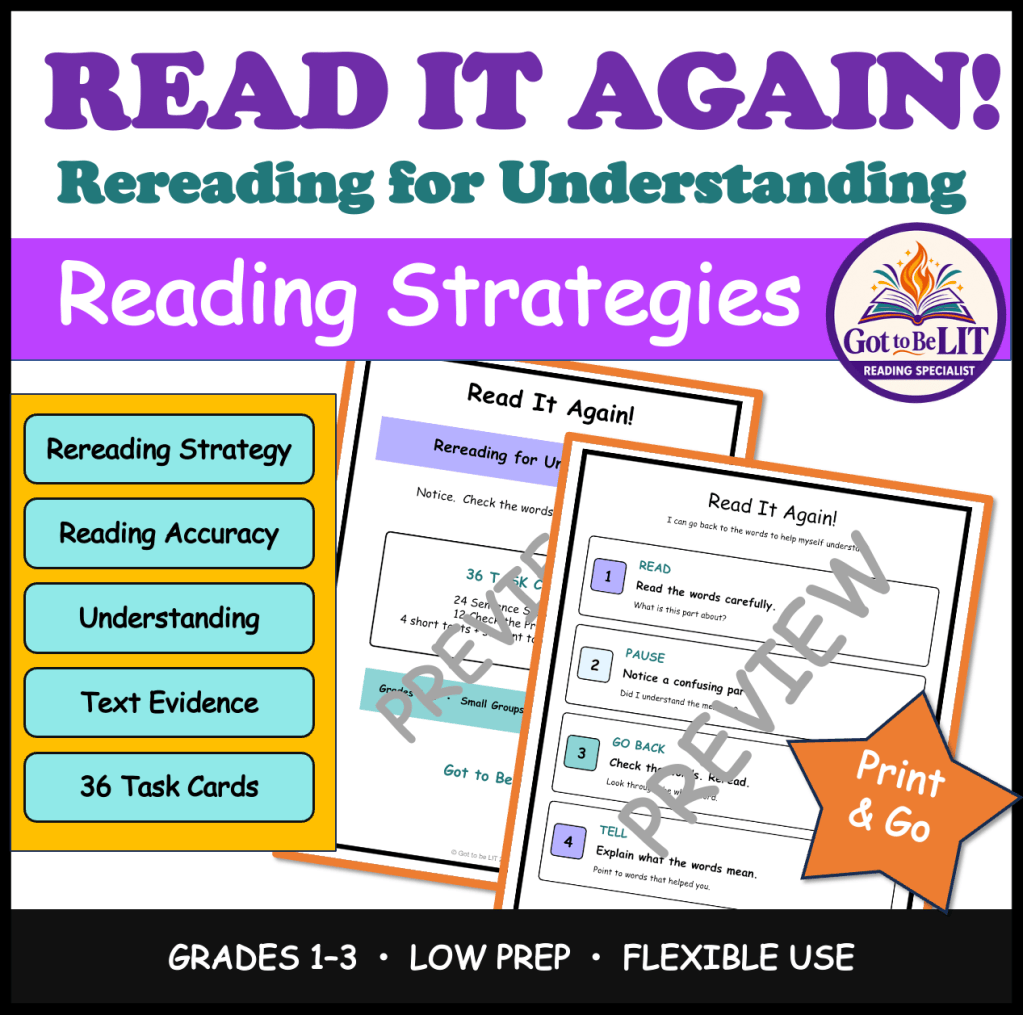
The resource also includes a modeled lesson, strategy poster, bookmarks, response pages, an organizer for familiar books, exit tickets, an informal observation tracker, answer guidance, and original short texts.
The activities are designed for teacher-led small groups, supported partner practice, and literacy centers after modeling. Because the sentences and passages are not organized around a controlled phonics sequence, teachers should preview the text and provide support based on each student’s word-reading skills.
The Goal: Readers Who Notice and Respond
Rereading is a small action with a powerful message: understanding matters.
That was the change I wanted to see in my son. I did not simply want him to reach the end of the page or pronounce every word. I wanted him to notice when the words did not make sense—and to know that he had the power to stop, check, and try again.
That is the real goal of teaching students to monitor their reading. When students learn to stop, check the print, read again, and explain, they begin to approach reading with greater care and independence. They discover that confusion is not a dead end. It is a signal—and they have a strategy for what to do next.
Sometimes the most important thing a young reader can learn is that understanding does not always happen on the first try. Good readers know when to read it again.
Ready to help your students become active reading monitors? Explore Read It Again! and give young readers a playful, practical way to practice rereading for accuracy and understanding.
Discover more from Got to be LIT
Subscribe to get the latest posts sent to your email.

