
When my children were growing up, the internet and smartphones were still changing the way families lived.
My husband and I had to make decisions that previous generations of parents had never faced. When should our children be allowed to use the internet? When were they ready for a phone? What rules and boundaries should we put in place?
We did our best, but there wasn’t a clear roadmap.
The internet gave our children access to wonderful information and opportunities. It also made it much easier for them to encounter things that were inaccurate, inappropriate, or simply beyond what they were ready to understand. There were things they saw that I wish they hadn’t.
Like many parents, we learned as we went.
Now, as I watch artificial intelligence become part of children’s lives, I can’t help feeling that we are standing at another crossroads.
Today’s elementary students are the first generation growing up alongside AI. In this post, we’ll examine what AI can support, where it may interfere with learning, and five practical ways parents and teachers can protect the thinking children still need to do for themselves.
AI Is Already Part of Childhood
Whether we are ready or not, AI is already appearing in educational programs, search tools, apps, games, and devices used by young children.
According to the 2025 Common Sense Census, 39 percent of parents of children ages 5 to 8 reported that their child had used an app or device with AI features to learn about school-related material.
Although this includes different kinds of AI, the number shows how quickly AI-enabled tools are becoming part of childhood.
Some children may know they are interacting with AI. Others may simply see it as another feature inside an app.
Either way, this technology is becoming part of how children find information, receive help, create content, and complete schoolwork.
That brings exciting possibilities—but it also raises questions we cannot afford to ignore.
The Possible Benefits of AI for Elementary Students
AI has the potential to provide students with support that might otherwise be difficult to access.
It can explain a concept in a different way, simplify complicated directions, read text aloud, generate practice questions, or help a child brainstorm ideas. Used carefully, it may make learning more accessible for students with disabilities, language differences, or gaps in their background knowledge.
For a child who is stuck, an immediate hint can reduce frustration and provide the encouragement needed to continue.
AI can also inspire curiosity. A student can ask a question, explore a new topic, or receive an explanation almost instantly.
Those are meaningful benefits. I don’t think we should dismiss them simply because the technology is new.
At the same time, easy access to an answer does not guarantee that learning has taken place.
Better Performance Does Not Always Mean Deeper Learning
This may be one of the most important distinctions for teachers and parents to understand:
AI can improve what a student produces without necessarily improving what the student knows or can do independently.
The American Psychological Association cautions that educational technology can improve immediate performance without building the underlying knowledge and skills a child can apply elsewhere. An AI-assisted essay may be more polished, for example, but that does not necessarily mean the student has become a stronger writer. APA guidance on educational technology
This matters because the finished product is only one part of learning.
When a child writes a paragraph, we are not simply looking for five error-free sentences. We want that child to practice generating ideas, organizing thoughts, choosing words, forming sentences, revising, and persisting when the task becomes difficult.
When a student solves a math problem, we want more than the correct answer. We want the student to understand the process and eventually apply it without assistance.
When a child determines the meaning of an unfamiliar word, we want that student to notice word parts, examine context clues, make connections, and think about which meaning makes sense.
AI can help produce an answer in each of these situations. But if it does too much of the thinking, the final product may conceal the skills a child has not yet developed.
What Might We Notice in the Short Term?
In the short term, AI may help some children feel more successful.
Students might complete their work more quickly, receive extra support, or produce writing that looks more advanced. With adult guidance, an AI-generated question or idea might help a hesitant child finally get words onto the page.
These benefits are easy to see.
The possible disadvantages may be harder to recognize.
A student might begin asking AI for help before attempting a task. An inaccurate answer may be accepted because it sounds confident. A teacher may look at a polished assignment and assume the child understands more than they actually do.
AI could also remove some of the productive struggle children need. Struggle is not always a sign that something has gone wrong. In the right amount, it is how students learn to tolerate frustration, try a different strategy, and discover that they can solve difficult problems.
If technology removes every uncomfortable moment, children may lose valuable opportunities to build independence and perseverance.
What Could the Long-Term Effects Be?
This is where we need to be honest: We do not yet know.
Research into the effects of generative AI on children’s cognitive, social, and emotional development is still in its early stages. Many of the long-term questions remain open. American Psychological Association
Will children who use AI become skilled at asking questions, evaluating information, and collaborating with technology?
Or will they become less confident in their ability to think, write, and solve problems without it?
Could AI help children explore their creativity—or encourage them to accept the first idea generated for them?
Will personalized support help struggling learners become more independent—or make them feel dependent on a tool that is always ready to provide the next answer?
How will regular interaction with technology that speaks like a person affect the way children understand trust, expertise, and human relationships?
We cannot answer these questions yet. Today’s elementary students are experiencing this transition in real time, while the adults responsible for guiding them are still learning too.
That doesn’t mean we should panic. It means we should pay attention.
Remembering What We Learned From the Internet
When the internet first entered our homes, we focused on access. We asked when children should be allowed online, which websites they could visit, and how much time they could spend in front of a screen.
Over time, we realized that access was only part of the conversation.
Children also needed help recognizing unreliable information, responding to inappropriate content, protecting their privacy, and understanding that being able to find information was not the same as being ready to process it.
Many of those lessons apply to AI, but AI adds another complication. It does not simply locate information. It can interpret questions, generate answers, imitate conversation, and create finished work.
That makes adult involvement even more important.
UNESCO’s guidance on generative AI in education emphasizes privacy, age-appropriate use, and a human-centered approach. For elementary students, AI should not quietly replace interaction with teachers, classmates, books, hands-on experiences, and their own developing minds.
5 Ways to Protect Learning When Children Use AI
AI can be a useful support, but children still need opportunities to think, struggle productively, and show what they can do independently. These five guidelines can help adults keep learning—not convenience—at the center.
1. Require an independent attempt first. Before AI is introduced as a support, give students time to try the task themselves. They can talk through an idea with a partner, write a first draft, draw a model, use manipulatives, return to the text, or explain their thinking aloud.
2. Ask students to explain their thinking. A polished answer does not show how much a child understands. Ask students to describe how they reached an answer, which evidence they used, and what they could do independently.
3. Verify AI-generated information. AI can produce inaccurate information in a confident voice. Teach children to compare important answers with a trusted source, the original text, or guidance from a knowledgeable adult.
4. Protect private information. Children should not enter names, locations, school information, photos, or other personal details into an AI tool. Use only school- or family-approved tools with appropriate adult supervision.
5. Preserve offline learning. Graphic organizers, handwritten responses, class discussions, partner activities, books, and hands-on experiences make student thinking visible. They show us what a child understands, where confusion remains, and which skills still need instruction.
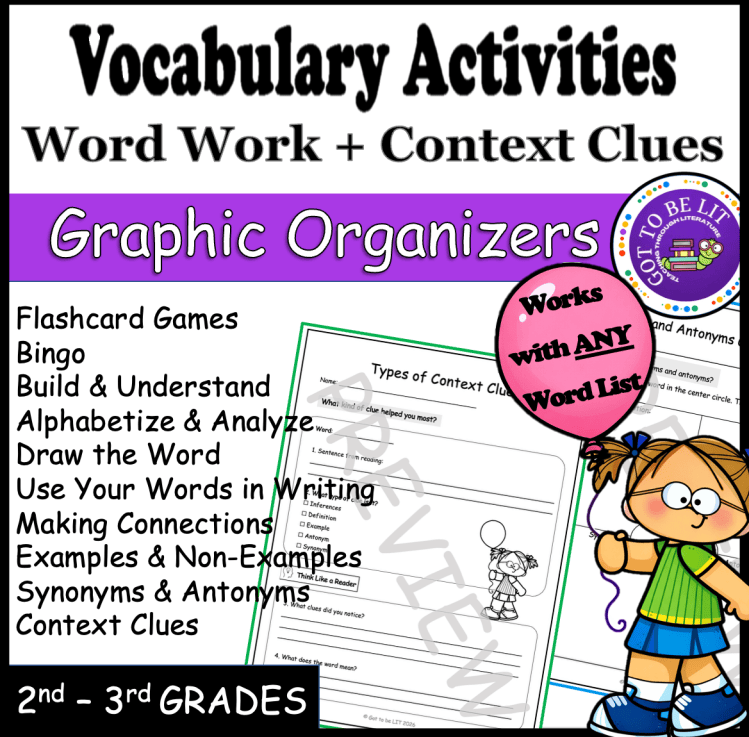
One way to preserve independent thinking is to use resources that require students to slow down and interact with their learning. My Vocabulary Graphic Organizers and Word Work Worksheets ask students to draw word meanings, consider examples and non-examples, identify synonyms and antonyms, examine context clues, make connections, and use vocabulary in their own writing. An AI tool can provide a quick definition, but independent work lets a teacher see whether the student truly understands the word.
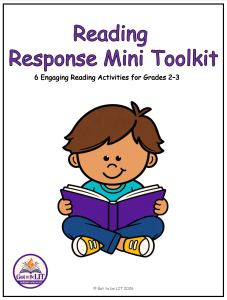
💜 FREE Reading Response Toolkit!
One way to protect independent thinking is to give students offline opportunities to respond to reading in their own words. Sign up for my Got to Be LIT Literacy Letter and receive 6 FREE reading response activities for grades 2–3 that make student thinking visible while strengthening comprehension.
Try this tomorrow: Before a child asks AI, pause for three questions: What have you already tried? What do you think the answer might be? How will you check whether the AI response is accurate?
Moving Forward With Caution and Curiosity
I don’t believe the answer is to pretend AI does not exist. Our children will grow up in a world where artificial intelligence is part of education, work, communication, and daily life.
They will need to understand how to use it.
But they will also need to know when not to use it.
They will need to question its answers, recognize its limitations, protect their privacy, and notice when convenience is replacing thought. Most importantly, they will need confidence in their own ability to think, create, solve problems, and persevere.
Parents and teachers may not have a complete roadmap yet. We can still begin with a clear purpose: Technology should support children’s development, not quietly take over the experiences through which development occurs. To explore this further, read Is AI Helping Students Learn? and The Importance of Comprehension Monitoring in Early Reading.
AI may offer real benefits, but today’s elementary students are also the first generation growing up alongside it. Our responsibility is not simply to prepare them to use AI—it is to make sure they continue learning how to think, create, question, and persevere without it.
What boundaries or routines are you using when elementary students encounter AI?


