
Have you ever taught a vocabulary word, practiced it with your students, and felt pretty confident that they understood it—only to ask about it a few days later and get blank stares?
I know I have!
The truth is, vocabulary words rarely stick after one lesson. Our students need to see, hear, say, and use a new word many times before it truly becomes part of their vocabulary.
And sometimes, they need to get out of their seats, too.
I recently watched Edutopia’s video, “How Movement and Repetition Help Vocabulary Stick,” and it immediately caught my attention. The routine featured in the video is simple, energetic, and easy to use—which is exactly the kind of classroom idea I love.
A Vocabulary Routine That Gets Students Moving
In the video, fifth-grade teacher Samantha DiCicco practices four or five vocabulary words with her students each day.
The students stand up, repeat each word, and clap or stomp its syllables. Next, they repeat a student-friendly definition and add a hand motion that represents the word’s meaning.
That’s it! It only takes a few minutes, but students are seeing the word, hearing it, saying it, and physically connecting to its meaning.
I especially love the idea of giving each word its own gesture. Later, when students encounter the word in a book or need to use it in conversation, that movement can serve as a little reminder.
Sometimes a simple hand motion is exactly the clue a student needs to retrieve a word’s meaning.
Repetition Doesn’t Have to Be Boring
We know students need repetition—but repetition doesn’t mean completing the same worksheet or reciting the same definition every day.
Students can revisit the same word in lots of different ways.
They can:
- Say it
- Clap its syllables
- Act it out
- Draw it
- Find synonyms and antonyms
- Think of examples and non-examples
- Look for it in a text
- Make a personal connection
- Use it in a sentence
The word stays the same, but the activity—and the thinking—changes.
This keeps practice from feeling stale while giving students the repeated exposure they need.
Try These Easy Movement Ideas
You don’t need to plan an entire movement lesson to make vocabulary practice more active. These quick ideas would be easy to add to a morning meeting, small group, reading lesson, or transition.
Clap or stomp the syllables
Say the word together and clap, tap, or stomp once for each syllable. This is a quick way to help students slow down, listen to the word, and practice pronouncing it correctly.
Make up a gesture
Ask students to think of a simple gesture that matches the word.
For enormous, they might stretch their arms as wide as they can. For fragile, they might pretend to carefully hold something that could break.
Use the same gesture each time you practice the word so students begin to connect the movement with its meaning.
Play vocabulary charades
Have one student act out a vocabulary word while the class tries to identify it. After students guess the word, ask someone to explain its meaning or use it in a sentence.
Create a human word sort
Choose one vocabulary word and place two category signs on opposite sides of the room. For one round, use synonym and antonym. Say a related word and have students move to the sign that shows how it relates to the vocabulary word.
For example, if the vocabulary word is fragile, students would move to synonym when they hear delicate and to antonym when they hear sturdy.
For another round, switch the signs to example and non-example. If the word is still fragile, a glass ornament would be an example, while a rubber ball would be a non-example.
After students move, ask a few volunteers to explain their choices. This turns a simple word sort into an active activity while helping you quickly see who understands the word.
Add a context-clue signal
Create a class motion students can use whenever they spot a helpful context clue. They might make a magnifying glass with their hands or point to the words that helped them figure out the meaning.
It’s simple, but it helps turn looking for context clues into something active and intentional.
Move First, Then Dig Deeper
Movement is a great way to introduce or review a word, but students also need time to slow down and really think about its meaning.
This is where I like to use graphic organizers.
After students say the word, clap its syllables, and practice its gesture, they can explore it on paper. They might draw the meaning, identify synonyms and antonyms, create examples and non-examples, examine context clues, or use the word in their own writing.
The movement gets students engaged. The graphic organizer helps them organize and deepen their thinking.
Together, the two activities create a routine that is active, meaningful, and manageable.
Looking for Ready-to-Use Vocabulary Practice?
My Vocabulary Graphic Organizers and Word Work Worksheets were created to help students interact with vocabulary words in a variety of ways.
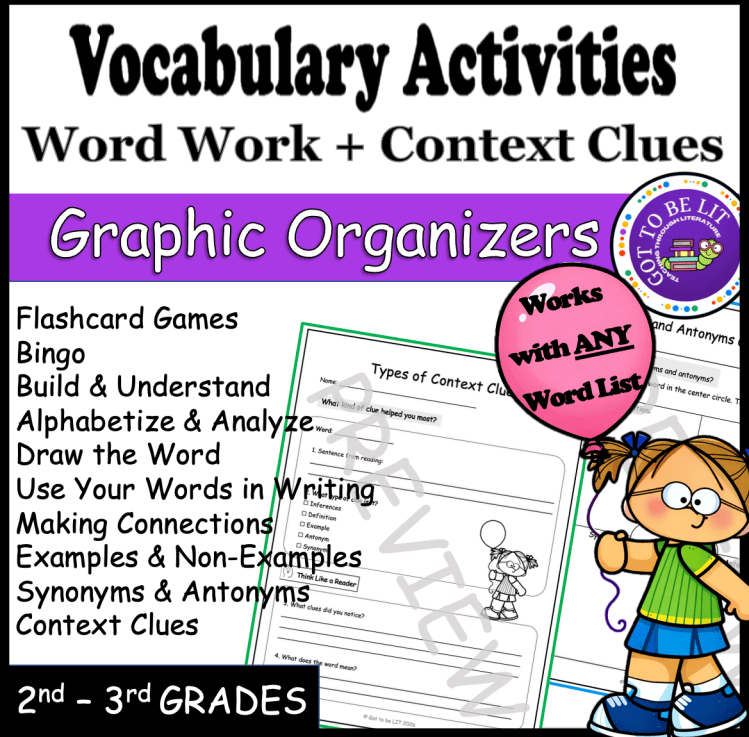
The activities can be used with any vocabulary list, so you can pair them with the words from your reading curriculum, a novel study, a science or social studies unit, or any text your students are reading.
Students can:
- Build a personal vocabulary word wall
- Practice with flash cards and Bingo
- Break apart and analyze words
- Draw word meanings
- Make text-to-self, text-to-text, and text-to-world connections
- Explore examples and non-examples
- Identify synonyms and antonyms
- Practice using context clues
- Apply new vocabulary in their writing
Instead of seeing a word once and moving on, students return to it again and again. Each activity gives them a new way to think about the word and make its meaning stick.
You could even begin with the movement routine from the Edutopia video and then choose one of the graphic organizers for independent or small-group practice.
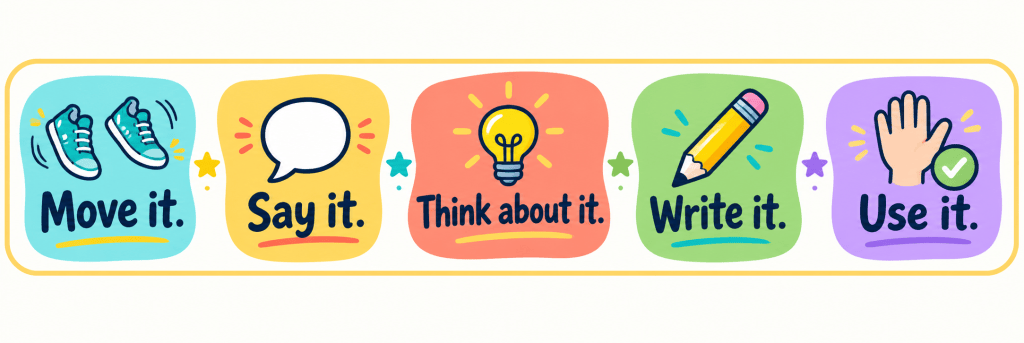
Move it. Say it. Think about it. Write it. Use it.
A Few Minutes Can Make a Big Difference
Vocabulary instruction doesn’t have to take up a huge chunk of the school day.
Choose a few important words. Introduce them before students encounter them in their reading. Add a chant, clap, stomp, or gesture. Then give students several opportunities to explore and use those words throughout the week.
A few fun, focused minutes each day can make a big difference.
When students experience words with their voices, minds, and bodies, vocabulary becomes more than a list of definitions to memorize. The words become meaningful—and that is when they are much more likely to stick.


I love the simple ideas for incorporating movement into vocabulary. Short bursts of movement spaced out throughout the day is not only great for scholastic retention, but also for the brain, metabolism, and body as a whole. Looking forward to watching the link!
LikeLiked by 1 person
Thanks, Diane! I knew you would appreciate this article. 😊
LikeLike