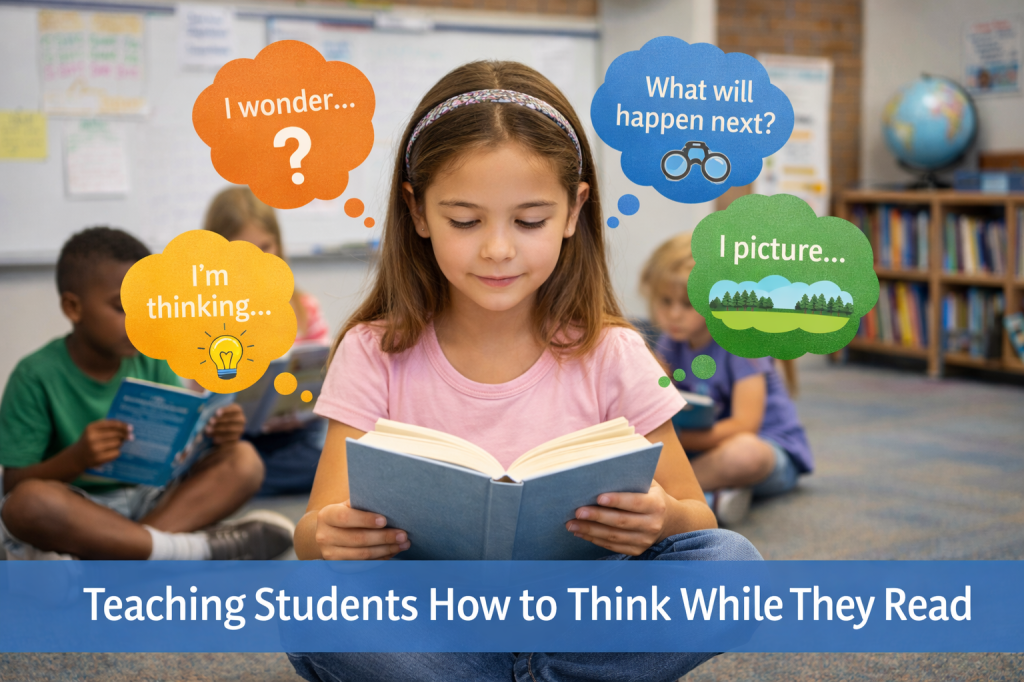
Have you ever asked a comprehension question and watched students flip frantically back through the book, hoping the answer will jump out at them?
Many young readers believe comprehension is about finding answers, not thinking through the text. They read the words, but their minds aren’t actively engaged. When this happens, comprehension feels hard—not because students can’tunderstand, but because they don’t yet know how to think while they read.
The good news? Thinking strategies can be taught. When we show students what readers do in their heads—and give them simple tools to practice—it changes everything.
🧠 Why Thinking Strategies Matter
Reading comprehension is not passive. Strong readers are constantly:
- Asking questions
- Making predictions
- Visualizing scenes
- Connecting ideas
- Checking for understanding
Struggling comprehenders often don’t do these things automatically. They assume reading means saying the words correctly and moving on. That’s why direct instruction in thinking strategies is so powerful—especially in grades 1–3.
When students learn how to think while reading, they gain control over their comprehension instead of relying on luck or memory.
🧩 What Does “Thinking While Reading” Look Like?
Thinking strategies are mental actions students use to make meaning from text. In the primary grades, we want to keep them simple, concrete, and repeatable.
Some of the most effective strategies for young readers include:
- Activating prior knowledge
- Asking questions
- Making connections
- Visualizing
- Predicting
- Rereading to clarify
The goal isn’t to teach all strategies at once—it’s to teach a few well and revisit them often.
🎤 Start With Think-Alouds
One of the most effective ways to teach thinking strategies is by modeling your own thinking out loud.
As you read a story aloud, pause and say things like:
- “Hmm… I’m wondering why the character did that.”
- “That part confused me, so I’m going to reread it.”
- “This reminds me of another story we read.”
These moments show students that confusion is normal—and that good readers do something about it.
💡 Many Got to Be LIT Book Companions include built-in stopping points that work perfectly for think-aloud modeling. Use the discussion prompts orally before students ever write their responses.
🖼️ Teach Students to Visualize
Young readers benefit greatly from learning to “make a movie” in their minds. Visualization helps them track events, understand characters, and remember details.
Try this during read-alouds:
- Pause and ask students to close their eyes.
- Say, “What do you see right now?”
- Invite them to describe colors, expressions, or actions.
You can also have students sketch quick pictures—not for art quality, but for meaning.
✏️ Sweet Reads + Skills packs often include drawing-based comprehension prompts that pair perfectly with visualization lessons.
❓ Teach Students to Ask Questions
Good readers are curious readers. Teach students that asking questions is a sign of strong comprehension—not confusion.
Introduce simple question stems like:
- “Why did…?”
- “What does this mean?”
- “What might happen next?”
Create a class anchor chart titled “Questions Good Readers Ask” and add to it all year long.
🎯 Reading Escape Rooms are a fun way to practice questioning—students must reread, analyze clues, and ask the right questions to solve each task.
🔁 Rereading Is a Strategy, Not a Failure
Many students think rereading means they “messed up.” Reframe it as a smart reader move.
Model phrases like:
- “That didn’t make sense—let me try again.”
- “I’m going to look for a clue I missed.”
Teach students to reread with a purpose:
- To find a detail
- To clarify meaning
- To confirm a prediction
When rereading becomes intentional, comprehension improves dramatically.
🧠 Use Strategy Prompts During Independent Reading
To help students apply thinking strategies on their own, provide simple prompts they can internalize.
Examples:
- “I think…”
- “I notice…”
- “This part shows…”
- “I’m confused because…”
You might display these on bookmarks, desk cards, or anchor charts.
💜 Many teachers use Got to Be LIT comprehension question stems as oral prompts before transitioning students to written responses.
🌈 Differentiation Tips
For Struggling Readers
- Focus on one strategy at a time
- Use short texts or familiar stories
- Practice orally before writing
For English Learners (ELLs)
- Pair strategies with visuals and gestures
- Offer sentence frames
- Allow partner discussions before sharing
For Advanced Students
- Ask them to explain why a strategy helped
- Have them compare two strategies
- Encourage independent strategy choice
✏️ Try This in Your Classroom
“Stop & Think” Reading Routine
- Choose a short story or passage.
- Place sticky notes at natural stopping points.
- At each stop, students answer one oral prompt:
- “What are you thinking right now?”
- “What do you predict?”
- “What clue helped you?”
Rotate prompts so students practice different strategies over time.
This routine builds metacognition without overwhelming young readers.
💭 Final Thoughts
When students learn how to think while they read, comprehension stops feeling mysterious. They begin to notice their own understanding—and take action when meaning breaks down.
Thinking strategies don’t replace phonics or fluency—they complete the reading puzzle.
And when students realize they control comprehension?
That’s when confident, thoughtful reading begins.
To check out my TpT store for more great resources, click the button below:
Discover more from Got to be LIT
Subscribe to get the latest posts sent to your email.

