
Have you ever led a reading discussion where you did all the talking — while students nodded, shrugged, or waited for the “right answer”?
Many students understand a text better than they can explain it. Others have ideas but don’t yet know how to participate in a discussion. Reciprocal teaching helps solve both problems by teaching students how to talk about what they read — and giving them ownership of the conversation.
When done well, reciprocal teaching turns reading discussions into active, student-led learning experiences that deepen comprehension and build confidence.
🧠 What Is Reciprocal Teaching?
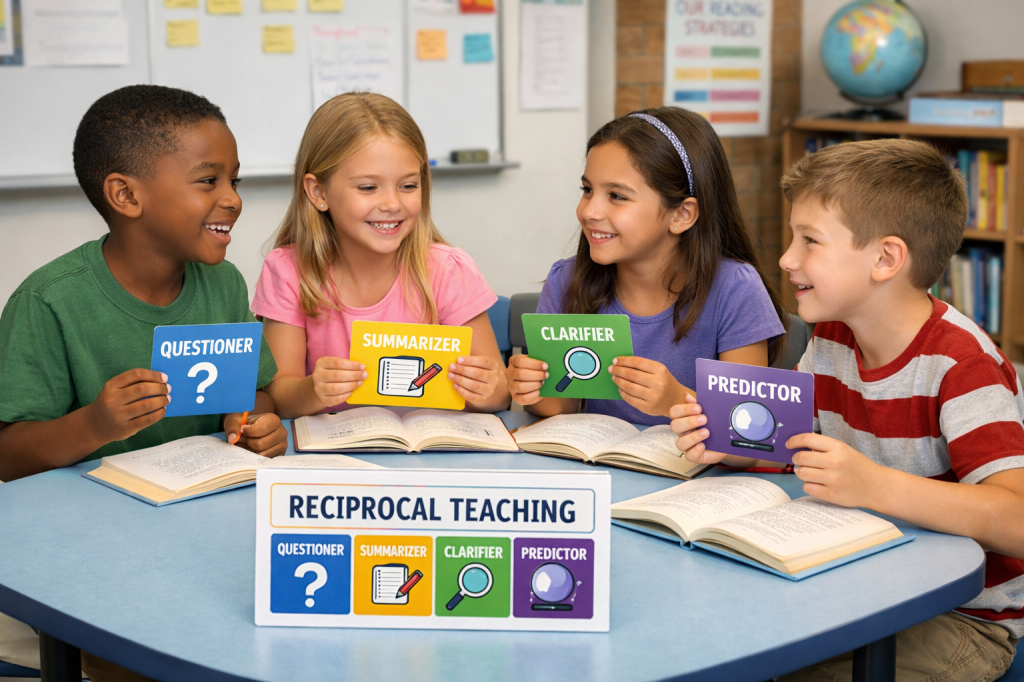
Reciprocal teaching is a structured discussion strategy where students take on specific roles to guide a conversation about a text. Instead of the teacher asking all the questions, students lead the thinking.
In elementary classrooms, reciprocal teaching typically includes four roles:
- Questioner – asks questions about confusing or important parts
- Summarizer – retells key events or ideas
- Clarifier – helps explain tricky words or sections
- Predictor – makes guesses about what will happen next
These roles encourage students to use the same thinking strategies strong readers use naturally.
📚 Why Reciprocal Teaching Improves Comprehension
Reciprocal teaching works because it combines several powerful comprehension practices at once:
- Students talk through their thinking
- They listen to multiple perspectives
- They practice summarizing, questioning, and predicting
- They become aware of how they understand text
Instead of passively answering questions, students are actively processing meaning — which leads to stronger comprehension and retention.
For grades 1–3, this structure is especially helpful because it:
- Reduces discussion anxiety
- Gives every student a purpose
- Supports language development through talk
🗣️ Teaching the Roles One at a Time
The key to success is introducing reciprocal teaching slowly. Don’t teach all four roles at once.
Step 1: Model Each Role
Use a familiar read-aloud and think aloud as you model each role.
Example teacher language:
- Questioner: “I’m wondering why the character made that choice.”
- Summarizer: “First this happened, then…”
- Clarifier: “This word is tricky. I think it means…”
- Predictor: “I predict that next…”
Step 2: Practice as a Whole Class
Assign one role at a time during shared reading. Let students practice orally while you guide.
🤝 Moving Reciprocal Teaching Into Small Groups
Once students understand the roles, you can move into partner work or small groups.
Here’s a simple structure:
- Read a short passage together (or listen to a read-aloud).
- Assign roles using cards or labels.
- Allow 5–10 minutes for discussion.
- Rotate roles regularly so all students practice each skill.
Keep group sizes small (3–4 students) to ensure everyone participates.
🧩 Sentence Stems That Support Student Talk
Sentence stems are essential for young learners and English language learners. They reduce cognitive load and increase confidence.
Examples by role:
Questioner
- “Why did…?”
- “What does this part mean?”
Summarizer
- “The most important part was…”
- “First…, then…”
Clarifier
- “This word means…”
- “I was confused, but now I think…”
Predictor
- “I think next…”
- “My prediction is…”
✏️ Many teachers use Got to Be LIT comprehension question stems orally before asking students to write responses.
🎯 Using Reciprocal Teaching With Different Texts
Reciprocal teaching isn’t just for chapter books — it works with:
- Picture books
- Short passages
- Nonfiction texts
- Seasonal stories
You can even use it during Reading Escape Rooms, where students must reread, discuss clues, and explain reasoning together to solve each task.
This makes reciprocal teaching feel purposeful and fun — not like another routine.
🌈 Differentiation Tips
For Struggling Readers
- Use familiar or teacher-read text
- Assign one role repeatedly until confidence builds
- Keep discussions short and focused
For English Learners (ELLs)
- Pair roles with visuals or icons
- Provide sentence stems
- Allow partner discussion before group sharing
For Advanced Students
- Ask them to justify answers using text evidence
- Have them coach peers through roles
- Let them generate discussion questions
✏️ Try This in Your Classroom
Reciprocal Teaching Mini-Round
- Read a short text aloud.
- Choose two roles only (Questioner + Summarizer).
- Discuss for 3–5 minutes.
- Share one group idea with the class.
This short routine introduces reciprocal teaching without overwhelming students and works well as a transition into deeper discussions.
💭 Final Thoughts
Reciprocal teaching helps students move from answering questions to thinking together. It builds comprehension, language skills, and confidence — all while giving students ownership of their learning.
When students lead the discussion, reading becomes something they do, not something that’s done to them.
To check out my TpT store for great resources, click the button below:
Discover more from Got to be LIT
Subscribe to get the latest posts sent to your email.

