

Chapter books can be magical 📚, but they can also be daunting for elementary students. Long texts, multiple characters, and plot twists can make it hard for young readers to stay focused or understand the story. That’s why scaffolding comprehension one chapter at a time is key 💡, especially for beginning chapter book readers.
Breaking the story into manageable chunks helps students:
- Track characters, events, and settings
- Build vocabulary in context
- Develop higher-order thinking skills
- Make predictions and connections
Here’s a step-by-step guide to scaffold comprehension in chapter books, along with examples, tips, and reflection prompts for your classroom.
1. Preview the Chapter 🔍
Purpose: Activate background knowledge and spark curiosity before reading.
Step-by-Step Implementation:
- Show students the chapter title and illustrations (if any).
- Ask guiding questions: “What do you think will happen in this chapter?” or “Who do you think will be involved?”
- Highlight any tricky vocabulary they might encounter.
Classroom Example:
Before Chapter 2 of Sophie Mouse and The Emerald Berries, students predicted what Sophie might discover in the forest. One student guessed, “I think Sophie will find something shiny and magical!” This created excitement and focus for reading.
⚠️Common Challenge: Students may guess without thinking.
✅Solution: Encourage text evidence and reasoning: “Why do you think that? Which clues in the story support your idea?”
✨Differentiation Tips:
- Struggling readers: Provide visual clues or a short summary of the previous chapter.
- Advanced readers: Ask them to make predictions about character decisions or themes.
💡 Reflection Prompt: Which part of your prediction came true? Which surprised you?
2. Read Actively 🎯
Purpose: Encourage students to interact with the text instead of reading passively.
Step-by-Step Implementation:
- Pause at key moments to ask comprehension questions.
- Encourage students to take notes.
- Ask students to identify important events, character actions, or problem-solving moments.
Classroom Example:
While reading Chapter 3, students underlined phrases that described Sophie’s cautious behavior and added notes: “Sophie is worried about Hattie—shows she is responsible.” This helped students remember details for discussion.
⚠️Common Challenge: Students may read quickly without stopping.
✅Solution: Model active reading by thinking aloud, showing how to mark text and jot down notes.
✨Differentiation Tips:
- Struggling readers: Provide guided questions or sentence starters for annotations.
- Advanced readers: Ask them to analyze character motives, themes, or connections to real life.
💡 Reflection Prompt: Which part of the chapter did you notice most closely, and why?
3. Summarize & Discuss 🗣️
Purpose: Reinforce understanding and encourage discussion of key points.
Step-by-Step Implementation:
- Ask students to summarize the chapter in 2–3 sentences or a quick sketch.
- Hold a class discussion, small-group conversation, or partner talk to share summaries.
- Prompt students to justify answers using evidence from the text.
Classroom Example:
After Chapter 4, a student summarized: “Sophie found a glimmering berry, and she wondered if it was safe. Hattie stayed by her side to help.” Discussing their summaries helped students catch details they might have missed.
⚠️Common Challenge: Students may give overly simple summaries.
✅Solution: Model how to summarize key events, emphasizing who, what, when, where, and why.
✨Differentiation Tips:
- Struggling readers: Allow visual summaries or sentence frames.
- Advanced readers: Include predictions, thematic analysis, or connections to previous chapters.
💡 Reflection Prompt: Which part of the chapter was most important for understanding the story, and why?
4. Track Characters & Events 📝
Purpose: Help students keep characters, settings, and events organized across chapters.
Step-by-Step Implementation:
- Use graphic organizers such as character charts, story maps, or timelines.
- Have students update the organizer after each chapter.
- Encourage reflection on changes in characters or plot development.
Classroom Example:
Students tracked Sophie, Hattie, and the squirrel’s actions across chapters. One student noted: “Sophie was nervous at first, but she became braver when she found the berries.”
⚠️Common Challenge: Students may forget details from earlier chapters.
✅Solution: Encourage review of previous chapters before starting a new one.
✨Differentiation Tips:
- Struggling readers: Provide partially completed organizers.
- Advanced readers: Add prediction sections or space for cause-and-effect analysis.
💡 Reflection Prompt: How has this character changed since the beginning of the story? What caused the change?
5. Reinforce Vocabulary & Key Concepts 🔤
Purpose: Support comprehension by building understanding of essential words and ideas.
Step-by-Step Implementation:
- Introduce key vocabulary before or during reading.
- Encourage students to use words in discussion, summaries, or writing prompts.
- Use interactive bookmarks, vocabulary webs, or word walls to reinforce learning.
Classroom Example:
A student illustrated “glimmering” by drawing the berries in the sunlight and used it in a sentence: “The berries were glimmering in the sunlight.” This reinforced understanding of vocabulary and the story context.
⚠️Common Challenge: Students may memorize definitions without understanding meaning.
✅Solution: Encourage students to apply words in context through discussion, writing, or illustrations.
✨Differentiation Tips:
- Struggling readers: Limit vocabulary to 2–3 key words per chapter with visuals.
- Advanced readers: Challenge them to use multiple words in their summaries or creative writing.
💡 Reflection Prompt: Which new word helped you understand the chapter best? Can you use it in your own writing?
Extra Tips for Teachers 🌈
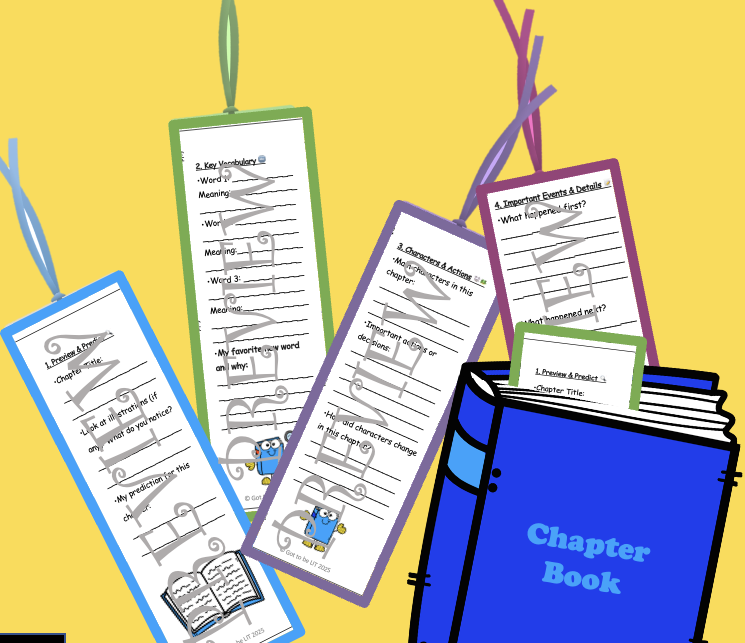
- Use Interactive Bookmarks: Chapter-by-chapter prompts help students stay on track and provide ready-to-go reflection opportunities 🖊️.
- Incorporate Small-Group Discussions: Rotate groups for focused skill practice and comprehension support 👥.
- Scaffold Gradually: Start with one skill per chapter, then combine summarizing, vocabulary, and reflection as students grow confident.
Final Thoughts💡
Building comprehension one chapter at a time transforms reading from overwhelming to manageable, engaging, and fun🌟. By previewing, reading actively, summarizing, tracking characters, and reinforcing vocabulary, students can master chapter texts with confidence.
If you want ready-to-go bookmarks, chapter-by-chapter comprehension guides, graphic organizers, and vocabulary activities for chapter books like Sophie Mouse and The Emerald Berries, check out my Got to Be LIT TpT store. These resources make teaching interactive, stress-free, and fun!
Discover more from Got to be LIT
Subscribe to get the latest posts sent to your email.

